If you've ever wondered how CBD goes from a hemp field to the bottle on your shelf, you're not alone. Understanding how CBD is made can help you choose higher-quality products and avoid low-grade alternatives.
At Eden's Herbals, we believe transparency matters. Here's a step-by-step look at how premium CBD products are created.
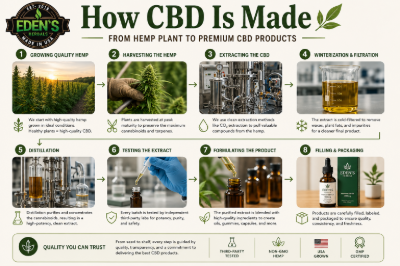
Step 1: Growing Quality Hemp
Everything begins with the hemp plant.
Industrial hemp is a variety of Cannabis sativa that contains very low levels of THC (less than 0.3% Delta-9 THC by dry weight under U.S. federal law). Instead of producing intoxicating effects, hemp is cultivated for its naturally occurring cannabinoids, terpenes, and other beneficial plant compounds.
The quality of the final CBD product depends heavily on:
- Healthy soil
- Clean water
- Responsible farming practices
- Proper harvesting techniques
- Careful drying and storage
High-quality hemp is the foundation of high-quality CBD.
Step 2: Harvesting the Hemp
Once the plants reach maturity, they're harvested at the ideal time to preserve cannabinoid content.
After harvesting, the plants are carefully dried to reduce moisture while helping maintain their natural compounds. Proper drying also helps protect the crop from mold and contamination.
Step 3: Extracting the CBD
The next step is removing the valuable compounds from the hemp plant.
Several extraction methods are used throughout the industry.
CO₂ Extraction
Supercritical CO₂ extraction is widely regarded as one of the cleanest extraction methods.
Benefits include:
- No harsh chemical residues
- Excellent preservation of cannabinoids
- High purity
- Environmentally friendly process
Many premium CBD brands prefer this method because it produces a clean, high-quality extract.
Ethanol Extraction
Food-grade ethanol is another commonly used extraction method.
Advantages include:
- Efficient processing
- Good cannabinoid recovery
- Suitable for large-scale production
When properly performed, ethanol extraction can also produce excellent CBD extracts.
Step 4: Winterization and Filtration
After extraction, the crude hemp extract contains:
- Plant waxes
- Chlorophyll
- Natural fats
- Lipids
- Cannabinoids
- Terpenes
The extract is refined through filtration and winterization to remove unwanted materials while preserving desirable compounds.
This results in a cleaner, more consistent extract.
Step 5: Distillation
Many manufacturers further purify the extract using distillation.
This process concentrates cannabinoids and removes additional impurities, helping create a cleaner final ingredient for CBD oils, gummies, capsules, topicals, and other products.
Step 6: Testing the Extract
One of the most important steps is third-party laboratory testing.
Independent laboratories analyze the extract for:
- CBD potency
- THC levels
- Other cannabinoids
- Heavy metals
- Pesticides
- Residual solvents
- Microbial contamination
These results are typically provided in a Certificate of Analysis (COA), which allows customers to verify the contents of a product.
Always choose CBD products that include recent third-party lab reports.
Step 7: Formulating the Final Product
The purified CBD extract is then blended into finished products.
Depending on the product type, manufacturers may combine the extract with:
- MCT oil
- Hemp seed oil
- Natural flavorings
- Botanical ingredients
- Essential oils (for topical products)
- Gummy ingredients
- Capsule ingredients
Careful formulation helps ensure each serving contains a consistent amount of CBD.
Step 8: Filling and Packaging
The finished products are carefully filled into bottles, jars, tubes, or pouches using quality-control procedures designed to promote consistency.
Each batch is typically assigned a lot number to support traceability and quality assurance.
Products are then packaged, labeled, and prepared for distribution.
Types of CBD Extract
Not all CBD products contain the same type of extract.
Full Spectrum CBD
Contains CBD along with naturally occurring cannabinoids, terpenes, and trace amounts of federally compliant THC.
Many consumers choose full-spectrum products because they retain more of the hemp plant's naturally occurring compounds.
Broad Spectrum CBD
Contains multiple cannabinoids and terpenes but is processed to remove THC.
This option appeals to people seeking a THC-free product while still enjoying a wider range of hemp compounds.
CBD Isolate
CBD isolate is purified to contain only CBD, with virtually all other plant compounds removed.
It is typically over 99% pure CBD.
What Makes High-Quality CBD?
When shopping for CBD, look for products that offer:
- Third-party lab testing
- Clearly labeled CBD content
- Transparent ingredient lists
- Batch numbers for traceability
- Hemp sourced from reputable growers
- Good manufacturing practices
Transparency is one of the strongest indicators of product quality.
Frequently Asked Questions
Is CBD made from marijuana?
Most CBD products sold in the United States are made from industrial hemp, not marijuana.
Does extraction remove THC?
Some extraction methods preserve naturally occurring THC, while additional processing can reduce or remove it, depending on the desired final product.
Why do lab reports matter?
Independent testing helps verify potency and screens for contaminants, giving consumers greater confidence in product quality.
Is all CBD made the same way?
No. Different manufacturers use different extraction methods, ingredients, testing standards, and quality-control procedures, which can affect the final product.
Final Thoughts
Making premium CBD involves much more than simply extracting oil from a hemp plant. From carefully grown hemp and advanced extraction techniques to rigorous laboratory testing and quality control, every step plays an important role in producing a consistent, high-quality product.
Understanding how CBD is made can help you make more informed purchasing decisions and choose products from brands that prioritize transparency, testing, and quality.

